
What makes a legal online casino Ontario site: two approvals, one directory
Approvals, directory, complaints
Two separate approvals stand behind every Ontario casino site: the AGCO registers the company, and iGaming Ontario signs a contract with it. Here is how the two fit together and how to confirm both for one site.
A legal online casino Ontario site is run by a company that holds two things at the same time: a registration from the AGCO and an operating agreement with iGaming Ontario. Either one on its own falls short. This page sets out what each approval does, how both show up in one public directory, what sits outside that system, where a complaint goes once the casino has answered, and how to match a casino's terms to the right company in a few minutes.
Two approvals behind a legal online casino Ontario operator
The AGCO is the regulator that the Gaming Control Act, 1992 empowers. Before a company may operate or supply online gaming here, the AGCO screens it: who owns it, how it is financed, and whether the people behind it have a criminal history. A company that passes becomes registered. The registration can come with conditions, and it can later be suspended or revoked. That two-approval structure is what puts an operator on the online casino Ontario Canada ranking, since only registered operators are scored there.
A registration answers one question only: is this company fit to take part? It does not, by itself, let the company offer casino games to anyone.
That permission comes from iGaming Ontario, the provincial agency that contracts with every private operator through a document called an operating agreement. The agreement sets out which products the operator may run and how it conducts games on the province's behalf. A contract is offered only to a company that already holds its AGCO registration, so the two approvals always arrive as a pair.
Why the Criminal Code puts the province in charge
Canadian gambling rules begin with a general prohibition in the Criminal Code and then carve out exceptions. The exception that matters here, s. 207(1)(a), allows the government of a province to conduct and manage a lottery scheme in that province, and casino games fall within that term. The phrase “conduct and manage” is demanding: the province has to run the scheme, not simply hand out permits and step back.
Ontario met that requirement with a split. iGaming Ontario conducts and manages the online market, while private companies run the websites under contract with it. In legal terms, a private brand is a party to the province's scheme rather than a free-standing licensee with a permit of its own.
This explains a detail that confuses many readers. An Ontario casino has no licence number to display in its footer, because no such number exists. The proof is a company name in a public directory.
The iGaming Ontario directory and the AGCO register are different lists
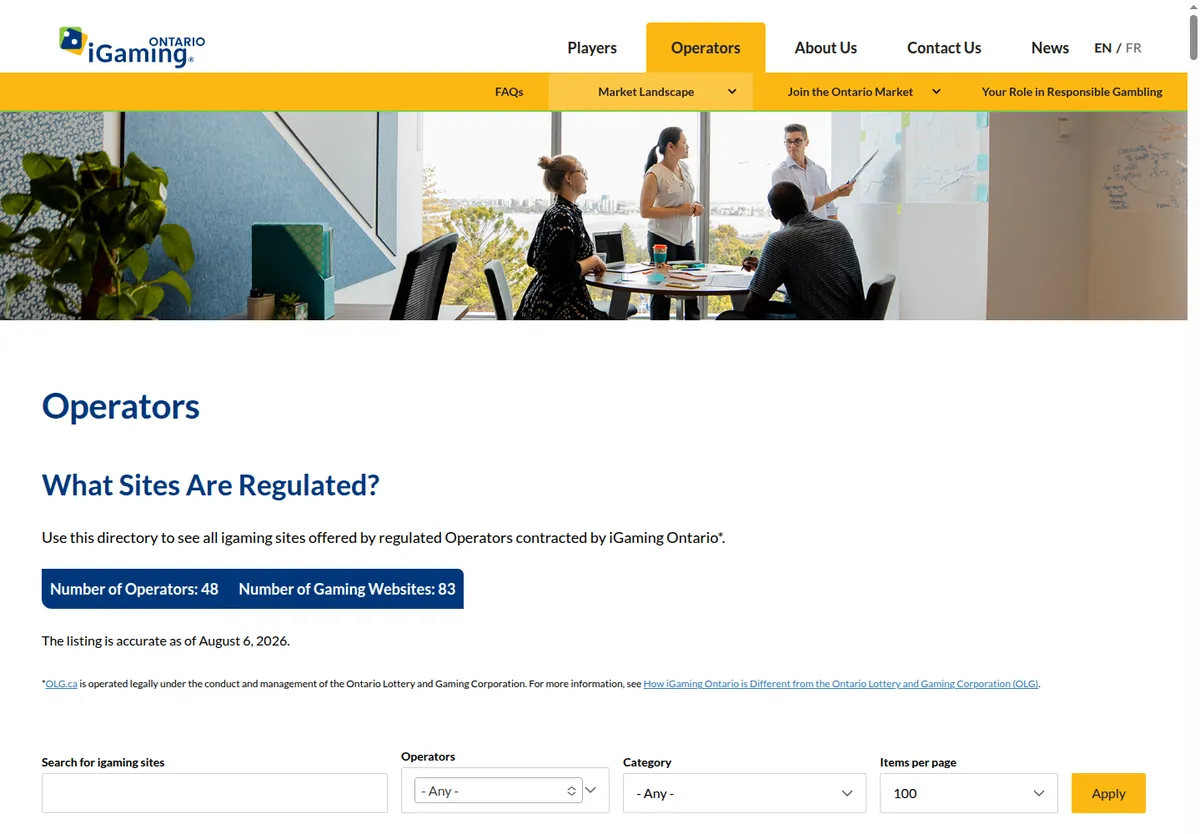
iGaming Ontario publishes a directory of the operators it works with and their gaming websites. The page states that it is accurate as of 6 August 2026. Read again on 16 September 2026, it showed 48 operators and more than 80 gaming websites, sorted into four product categories: Casino, Sports Betting, Poker and Bingo. Each website appears beside the company that runs it.
The AGCO keeps a register of its own, and it is broader. Besides operators it covers suppliers, such as companies that provide games or gaming technology. A supplier can appear there without running any site where you could open an account, so a search on the AGCO side may turn up names that have nothing to do with a casino.
For checking one casino, the iGaming Ontario directory is the more practical list. A website that appears there belongs to an operator holding both approvals. The AGCO register is where to confirm that a company's registration is still in good standing if a doubt remains.
Both lists use corporate names, not brand names, and one company often runs several brands. Cadtree Limited stands behind Jackpot City, Royal Vegas, Ruby Fortune and Spin Casino; Apollo Entertainment Ltd runs seven, among them Zodiac Casino and Yukon Gold Casino. The full grouping is on who owns which brand.
Where OLG fits
The Ontario Lottery and Gaming Corporation, a Crown corporation, owns and runs OLG.ca. Because the province operates that site through its own corporation, no private company needs screening and no contract is required. An agreement would amount to the province signing with itself.
That is why OLG does not appear in the iGaming Ontario directory. Its absence is expected and implies nothing against it. It simply runs through the other channel the Criminal Code exception allows: the province acting as operator. A search for OLG in the directory that comes back empty is therefore the correct result, not a gap in the list, and the same logic applies to the lottery products the corporation sells.
Age 19 and the account itself
The minimum age for online gaming here is 19, set by Standard 3.01 of the AGCO's Registrar's Standards for Internet Gaming. An operator cannot lower it for a promotion or a new product. Entering a false date of birth breaches the casino's terms and can cost the balance.
The operating agreement concerns the Ontario market, which is why the sign-up form asks for an address and a casino app may request location permission. Both are ordinary steps in opening an account. The sign-up guide takes the form and the identity check in the order they usually appear.
Why other provinces look different
Every province relies on the same Criminal Code exception, yet most have used it another way. Instead of contracting private brands, a provincial Crown corporation typically runs a single government gaming site itself: PlayNow in British Columbia, PlayAlberta in Alberta, Loto-Québec's site in Quebec, and Atlantic Lottery across the four Atlantic provinces. Manitoba and Saskatchewan use the PlayNow platform through their own Crown corporations.

Those provinces publish no directory of private operators, so there is nothing equivalent to compare a brand against. Alberta passed the iGaming Alberta Act in 2025 to build a competitive market on a model similar to Ontario's. What an Ontario account looks like in everyday Canadian terms, from CAD balances to Interac, is on across Canada.
Sites outside the Ontario framework
A gaming website that is neither in the iGaming Ontario directory nor OLG sits outside the Ontario framework. That is a statement about oversight, not an accusation of fraud. In practice it means no AGCO standard binds the operator, no operating agreement covers it, and the complaint route described below does not reach it.
This page does not present such sites as a choice and does not compare them with listed ones. Whether an individual commits an offence by using one depends on facts that a guide cannot know, and that question belongs with a lawyer rather than a web page.
Complaints: the casino first, then iGaming Ontario
Every registered operator must run a complaints process. Standard 1.15 requires a way to reach the operator about an account, funds or game play, and Standard 1.16 requires complaints to be recorded and handled in a fair and transparent way.
The order matters. A complaint starts with the casino's own formal procedure, and the reference number it issues is worth asking for in writing. The operator may take up to 90 days to reach a formal decision.
If that decision leaves the matter unresolved, or no decision comes within that period, the complaint can be escalated to iGaming Ontario. The AGCO, for its part, examines whether an operator broke the conditions of its registration; it has said it cannot recover money for an individual. A concern about responsible gambling measures can go to the AGCO without waiting for the operator. How to prepare the first letter, with evidence and clause numbers, is covered in the complaints guide.
Tax questions belong with the CRA
Nothing the AGCO or iGaming Ontario publishes addresses how winnings are treated for tax. That is a matter for the Canada Revenue Agency, and the answer depends on the situation of the individual who was paid, not on the casino that sent the money.
For a specific situation, the CRA's own guidance or a qualified tax professional is the reliable source, and casino sites, this one included, are not. Good records help whichever way the answer goes; the explainer on account statements lists what to download and keep.
Confirming a legal online casino Ontario site in four steps
- Open the iGaming Ontario directory and find the exact web address of the casino, not just a similar brand name.
- Note the operator printed beside that address.
- Open the casino's terms and conditions and find the company they name, usually in the opening clause or the page footer.
- Compare the two names.
Matches are usually plain. BetMGM Casino's general terms name BetMGM Canada Inc., the operator the directory shows for casino.on.betmgm.ca. The user agreement at 888casino.ca names VHL Ontario Limited, and so does the directory. Caesars Palace Online Casino's terms print “American Wagering, Inc.” while the directory prints “American Wagering Inc”, which is a punctuation difference rather than a different company.
If the names differ in substance, or the terms name no company at all, that is the moment to stop before a deposit. The pre-deposit check continues from here into identity clauses, sums, deadlines and withdrawal caps.
If gambling has started to feel out of control, ConnexOntario answers at 1-866-531-2600, 24/7, and Gamblers Anonymous runs meetings across the country. The account tools every casino must offer are described on responsible gambling.